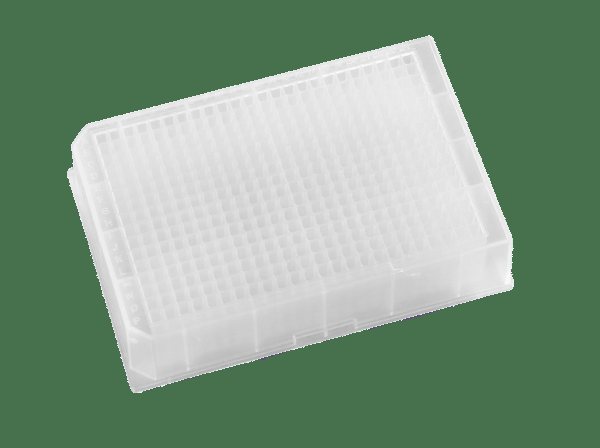
384 Square Deep Well Plate
AWLS-219240
Square wells pack more storage volume into the 384 footprint, so library and prep plates hold more per well while staying on the standard 4.5 mm pitch your handler already runs.
See it at Arctic WhiteA 384 plate quadruples your throughput in the same footprint, but the wells are small enough that sloppy liquid handling and evaporation stop being annoyances and start being results.
A 384 well plate packs 16 rows by 24 columns into the same standard footprint as a 96 well plate, 127.76 mm by 85.48 mm, with wells on a 4.5 mm pitch. Working volumes run roughly 5 to 120 microliters depending on the type. That density is the whole point: more samples per plate, less reagent per data point. It is also the whole risk, because every mistake you can make at 96, transposed wells, uneven fills, dried out edge wells, happens faster and is harder to see at 384.
Labs switch when the reagent bill or the queue does the arguing. A screening lab burning expensive compounds or antibodies at 96 well volumes cuts reagent cost per well by moving the same assay into 20 to 50 microliters. Core facilities and compound management groups switch for throughput: four 96 well plates consolidate into one 384, which means fewer plates to seal, stack, and track, and a liquid handler run that finishes in a fraction of the deck time. If your bottleneck is cost per data point or plates per day, 384 pays. If it is hands, it may not.
Nobody pipettes 384 well plates well for long by hand. The format assumes a liquid handler or at least a good multichannel pipette and a practiced hand, because a 5 microliter dispense error that 96 forgives is a failed well at 384. Small volumes also evaporate quickly, and the perimeter wells dry first, so sealing, humidity control, and short open times on the bench are part of the format, not accessories. Budget for the handling and sealing your assay needs before you count the reagent savings.
Assay plates are the screening default: flat bottomed, clear for absorbance, black for fluorescence, white for luminescence, sized for plate reader optics. Deep well 384 plates use square wells to store and prep samples in the 100 microliter class, the format compound libraries live in. PCR plates in 384 are thin walled and fully skirted so robots can grip and move them between handler and cycler without flexing. Pick by where the plate spends its life: reader, freezer, or cycler.
| Type | Typical working volume | Pick it when |
|---|---|---|
| Assay (clear, black, white) | 5 to 100 microliters | High throughput screening and plate reader assays |
| Deep well, square well | Up to about 120 microliters class | Compound storage, sample prep, library plates |
| PCR, fully skirted | Low microliter range | Automated PCR and qPCR workflows |
Volumes are working ranges for common plates; check the specific plate before a regulated run.
AWLS-219240
Square wells pack more storage volume into the 384 footprint, so library and prep plates hold more per well while staying on the standard 4.5 mm pitch your handler already runs.
See it at Arctic WhiteIt depends on the type. Assay plates typically work in the 5 to 100 microliter range, square well deep well plates reach roughly the 120 microliter class, and PCR plates sit at the low end. Working volume is always lower than total volume; leave headroom for mixing and sealing.
The standard footprint is 127.76 mm long by 85.48 mm wide (ANSI/SLAS), the same as a 96 well plate, with 384 wells in 16 rows by 24 columns on a 4.5 mm spacing. Total height varies by type, low for assay plates and taller for deep well storage plates.
Yes, with a multichannel pipette and small, careful volumes, for short runs and setup work. For production screening, no: the volumes are too small and the well count too high for hand pipetting to stay accurate across a full plate. Realistically, 384 is an automation format.
Switch when reagent cost per well or plate throughput is your bottleneck and you have liquid handling that can dispense a few microliters accurately. Stay at 96 when samples are viscous, when cells need more growth area, or when the workflow is manual. The reagent savings are real only if the rerun rate does not eat them.
Total volume, filled to the brim, runs well above the working ranges. A standard assay well holds roughly 90 to 130 microliters in total, a square well deep well plate about 240 to 300 microliters, and a 384 PCR well around 40 microliters. Working volume should stay under those numbers, because wells need headroom for mixing, sealing, and pipetting error. Exact totals vary by maker, so check the specification of the specific plate before a regulated run.
For cell culture, about 0.06 cm2 per well in a standard round well plate; 0.056 cm2 is the commonly published figure. Square well formats run larger, up to about 0.1 cm2. That is roughly a fifth of the growth area of a 96 well, which is why 384 culture suits short endpoint assays better than long growth. The exact area varies by maker and well geometry, so use the figure from the plate maker for seeding calculations.
Polystyrene for assay and cell culture plates, where optical clarity and a treatable growth surface matter, and polypropylene for deep well storage and PCR plates, where chemical resistance and temperature range matter. Most 384 plates a lab buys are one of the two. Check the material before assuming a plate tolerates DMSO or freezing.
High throughput screening first: more samples per plate at lower volumes, in drug discovery and assay development. The same format serves compound storage in deep well plates, automated PCR and qPCR, and miniaturized cell based assays. Any workflow where reagent cost per data point or plates per day is the bottleneck is a 384 candidate.
Scale by growth area. A 384 well offers about 0.06 cm2, roughly a fifth of a 96 well, so a line you seed at 10,000 cells per 96 well lands around 2,000 cells per 384 well. Many endpoint assays seed in the low thousands per well and read within a few days. The right number is line and assay dependent; titrate it in the format rather than borrowing a 96 well protocol unchanged.